Indirect Share
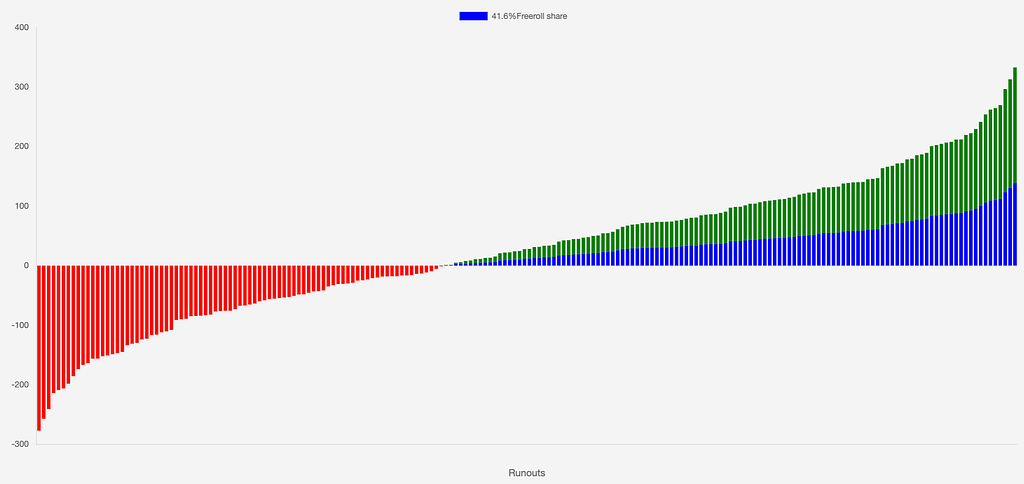
In 2014, I developed a Triple Draw poker solver. A customer and I agreed that a fair deal would be for me to receive a 40% share of his poker action, which meant I would get 40% of his winnings and cover 40% of his losses.
However, he was playing in high-stake games with blinds up to $2000. To manage the variance at those stakes, I would require a bankroll above $1,000,000, which I did not have at the time.
Below I will describe the method we called Indirect Share that allowed me to have 40% of customer’s Expected Value (EV) with no downside.
Solutions that didn’t work
Constant Amount: A naive solution is to estimate customer’s EV and pay me a lump or monthly sum for the access to the solver, but this approach has significant risks.
If the customer pays, for example $300,000, but doesn’t get enough action to justify the expense, he would be understandably upset.
Conversely, if I receive $300,000 and the customer then wins $5 million from games only made possible by my solver, the arrangement would seem grossly unfair to me.
Freeroll Share: A more equitable solution might be for me to receive a smaller percentage of the winnings, say 15%, if the customer profits annually, without compensating for losses.
While this approach is fairer, it could still result in me receiving significantly less than the aimed 40% share, especially in highly profitable scenarios for the customer. It could also lead to situations where a customer gives up more than 100% of his expected value.
Indirect Share
We devised a method where I would receive a Freeroll Share, with the percentage determined post-factum, at the end of a 6-months period.
The method would calculate Freeroll Share percentage that has Expected Value of regular share.
As an input the method would take a number of hands played per opponent per stakes, and estimated winrates against every opponent.
Examples
Standard Deviation of 52 bb / 100 hands is assumed.
Note that winrates must be estimated, as historical winrates are too noisy.
- In a 500 hands match with estimated winrate of 0.5bb/100, a 5.2% freeroll share equals the EV of a 100% regular share.
- In a 1000 hands match with an estimated winrate of 3.5bb/100 , a 41.4% freeroll share has the same EV as 100% regular share.
- If hero played 500 hands with estimated winrate of 0.5bb/100 and 1000 hands with estimated winrate of 3.5bb/100, a 37.3% freeroll share has the same EV as 100% regular share.
Calculation Method
- A program simulates multiple runouts given a list of (winrate, stakes, hands played, standard deviation). Then it calculates EV if runouts with negative results are replaced with 0.