How I made my first million, and took down Phil Ivey along the way — story of Draw Solver
Year 2006. I’m in 10th grade, and after solving advanced math problems at school, I rode home on an overcrowded Moscow trolleybus with a classmate. He told me about the Million Dollar Homepage, and I felt a mix of jealousy and frustration. It seemed so simple to create — something I could have done! A million dollars was my ultimate dream, but it felt like a Hollywood fantasy. My family was dirt-poor, and the richest person I knew made $2,000 a month as a programmer at a bank. My friend and I constantly fantasized about unrealistic money-making schemes.
In the following years, I competed in programming contests, studied math at university, and dropped out in 2010 to play poker professionally. At my peak, I played $1,000 buy-in cash games, though I eventually had to move down to $200 buy-ins. In 2013, I created and sold the Holdem solver.
2–7 Triple Draw.
In the summer of 2013, after making a Holdem solver deal with Trueteller, we had a Skype call where he mentioned that solving an obscure poker variant called 2–7 Triple Draw could make me a million dollars. I felt a euphoric rush when I heard this — I could finally turn my fantasy into reality, and Trueteller knew exactly what he was talking about.
There was a regular game with a $2,000 Big Blind at PokerStars ($200,000 buy-in), and there was no lower-mid stakes action for practice, which made a hypothetical solver even more valuable.
In 2–7 Triple Draw, each player gets 5 cards, and the goal is to have the lowest possible poker combination. The best possible hand is High card 7 (hence 2–7):
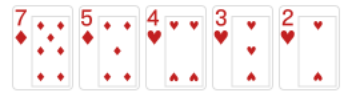
(You can’t have High card 6, as 2 3 4 5 6 is a Straight). In this game variant, player can discard cards of their choice and draw replacements from the deck. There are 3 rounds of drawing, hence Triple Draw.
I started working on the solution.
Technical Details
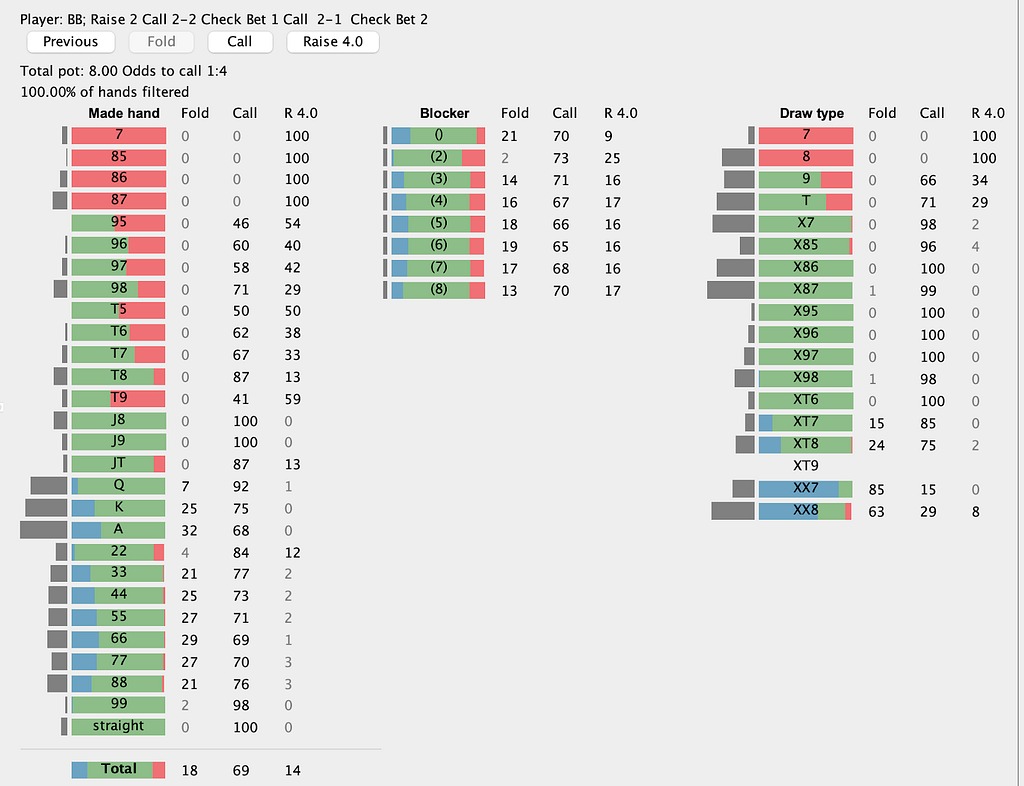
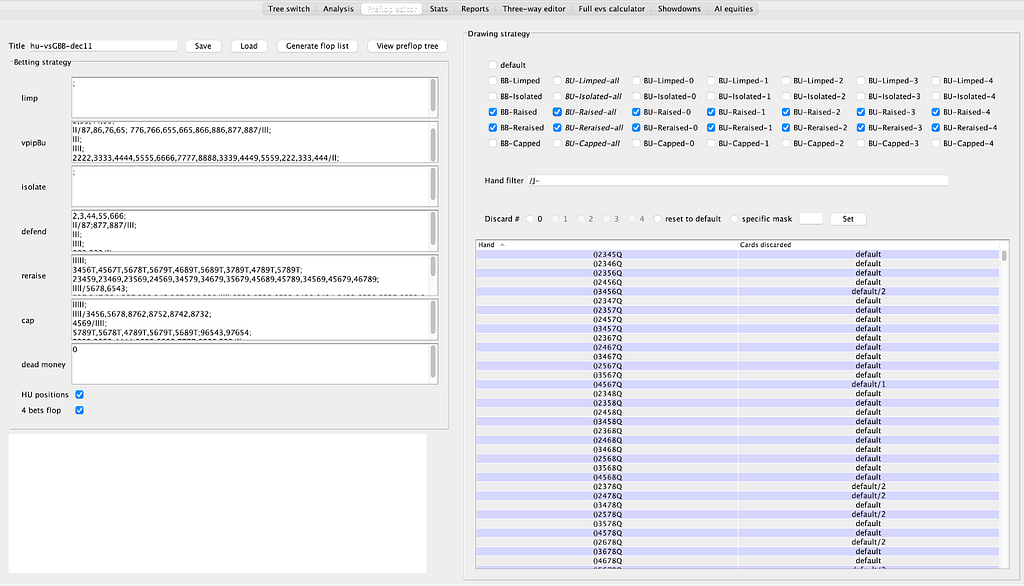
The game seemed to be impossible to solve as a whole, so we handcrafted preflop and 1st draw strategies, which allowed us to independently solve subtrees starting at the 2nd betting round, mimicking the Holdem solver approach where we solved the game starting from the flop.
One calculation ran for 3 days on ~1000 CPU cores in total, and cost around $1000. With experiments, iterations and different versions, I probably ran 20 of them.
Once we had all “flop” strategies, we would calculate preflop EVs and see which hands were not playing the max EV move. We would then adjust the strategy by hand and run the next iteration.
We quickly realized that discarded blockers are a big deal, and I improved the solver to keep track of one discarded card. Discards are a massive pain to account for, but boy they paid off — read on.
A year later, I improved my implementation to calculate the strategy from the preflop. It is a sip of fresh air to let the machine solve the whole game at once and not babysit & restart 30 sub-calculations and integrate the results with the handcrafted part. End-to-end solutions are also more precise.
In 2024, I have a reasonably good 6-max solution, as I made good progress with the algorithm, efficient game tree construction, and abstraction techniques, and Amazon made progress on instances with a lot of RAM.
The Deal
Once I had the solver working, we had to make a deal. For a buyer it would be tricky to pay $100,000s for a solution which they cannot verify. But I was confident that my program works, so I made a deal with Trueteller and RaulGonzalez where I would get 40% of their results, going down to 10% over 2 years. If they lost, I would pay them.
At that time 2 years seemed like an impossibly far future, so I didn’t negotiate enough for it. In hindsight, my customers are making money for many years after learning TDFL. Nowadays I charge more.
This worked well because (a) they were learning the game from scratch, and all of the profits could be safely attributed to my training and (b) online games at the time were public, so the results were transparent.
The partnership motivated me greatly to improve the product. Raul said:
“Working with the Draw solver was the best learning experience I ever had in poker.
Often, I requested a feature without knowing exactly how it should look or if it was even possible. I’d ask you about it, and half an hour later, you’d send me a new version with the feature implemented better than I had imagined, plus something extra. That was a great experience.”
Our deal included two years of exclusivity (2014–2015). While I’m not a fan of secrecy and exclusivity, it worked out extremely well for that game and time period.
Taking a direct 40% share at the highest stakes wasn’t feasible, as the variance of a $2000 big blind game would require a $1,000,000+ bankroll which I had not at that moment. Instead, we devised an elegant solution called the Indirect Share allowing me to have 40% EV without the downside.
The idea is that I get a freeroll, i.e. I get % of their winnings at the end of a period, but not % of their losses. The tricky part is to calculate what freeroll % corresponds to 40% EV, and it’s impossible to do beforehand, since 1% freeroll for a single hand is worth >100% EV, and 1% freeroll for a 100,000 hands with any reasonable winrate is worth almost 1% EV. So we had to choose freeroll % after the fact based on the amount of hands played. I wrote some more details here — Indirect Share.
I considered learning the game myself, and actually studied and played another variant, Draw Hi. However, learning and executing the strategy is a ton of work, and I decided to focus purely on developing software.
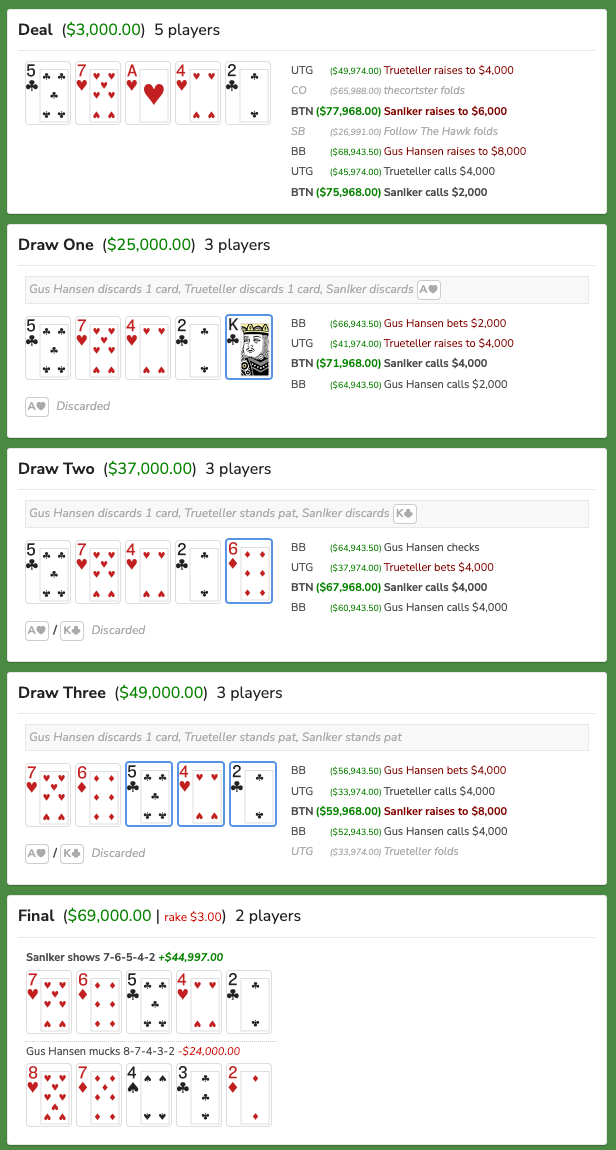
Trueteller and RaulG studied intensively, and in a couple months began battling $2000/$4000 heads-up and ring tables. Gus Hansen was one of the regular opponents:
King of the Hill on Stars
At PokerStars, the “King of the Hill” system was used for 1x1 cash game tables. When no games were active, only one table was open at the $2000/$4000 level. A professional would sit at the table all day, waiting for an amateur to join. Sometimes, another professional would join the table for a battle, and whoever decided to quit would lose the chance to play against a weaker player later. The equilibrium was for the best player to sit most of the time.
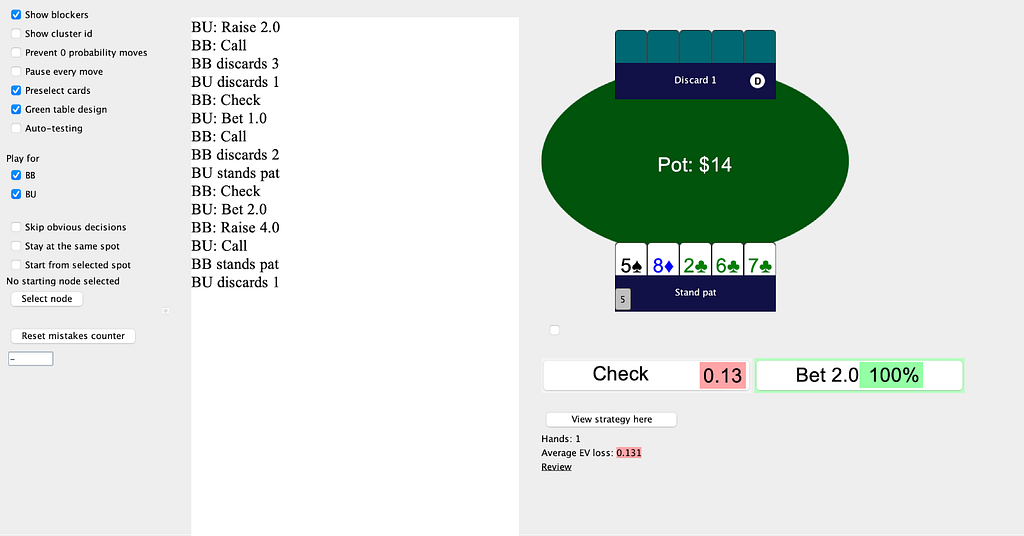
Before we came along in 2014, a group of professionals dominated the Triple Draw tables, and no other pros would challenge them. We learned years later that they also studied using a solver, but theirs did not consider discarded cards. Mine did — just a single card, but this single discarded blocker led to a completely new strategy: a raise on the turn after 1–1 discards.
That group believed they knew the true GTO strategy and thought Trueteller and Raul were playing weirdly, so they kept playing.
The group played 40,000 hands against Trueteller and Raul. We won around $700,000 from them before they quit. We estimate our edge against them at 1 big blind per 100. Besides the extra blocker, I think that Trueteller and Raul were also higher class players.
However, those guys were one year earlier than us, and they were truly uncontested and made probably 10 million because they were the first.
Too Much Money
In 2013–2015, my bankroll grew from $20,000 to $1,000,000 in 2.5 years, and I struggled to adjust psychologically.
The swings were intense — RaulG’s best day was 26th July 2014: +704k, and biggest daily loss: 28th November 2014, -346k
Freeroll deal accounting makes it complicated, but either way I wasn’t ready for those amounts. As a professional poker player myself, I never had more than $2000 at the table, and my single biggest daily swing was $10,000. Between Raul and Trueteller now my swings were up to 50-100k per day.
To distract myself, I fell into a Dota 2 coma. I clocked 2000 hours in Dota in year 2014. I would sometimes take a small break to add a feature to the solver, but I was chain-queueing those matches. Three times I had 24-hour+ Dota sessions.
I requested not to receive daily updates (only notify me if a certain negative threshold was crossed, so I would adjust my bankroll management), and we did accounting every 3–6 months.
I am embarrassed to say this — but I have never seen my customers play in real-time, online or live. There is something real and scary about seeing the result of my work.
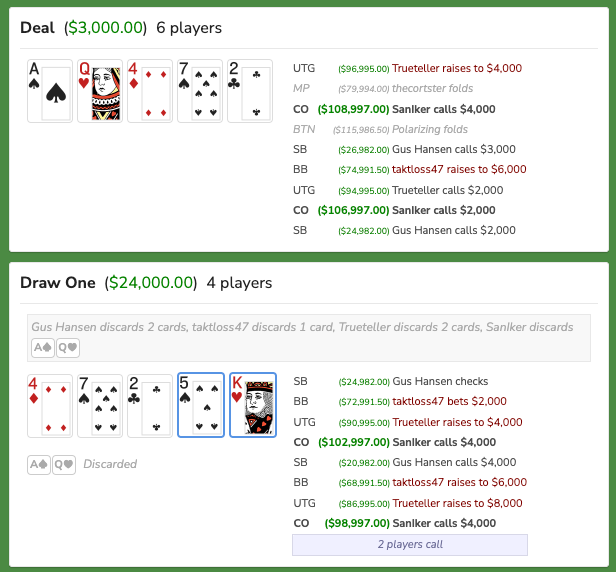
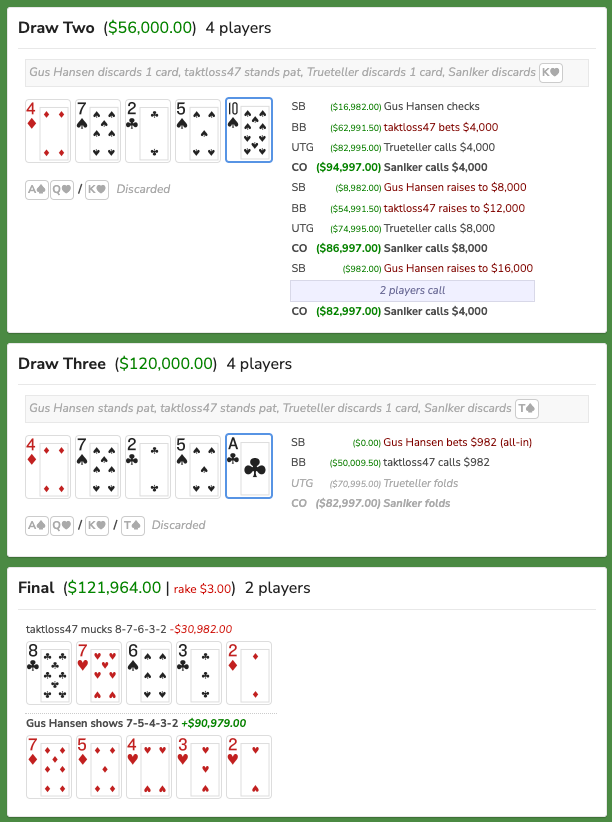
In this hand, pretty brutal having both the players I have a piece of fold to a $980 bet into a $120,000 pot, good job I never watched them play:
What this meant to me
Creating something unique and helping people to reach the very top was satisfying.
It was a constant pain for me growing up — I always had smarter classmates, never got a 1st place in math or programming competition, never reach the top in poker — highest I played was NL5000 shortstack, but even that was at the short peak of my career.
With Draw solver I felt that finally I am the best in the world at something, working together with legends — against the legends too.
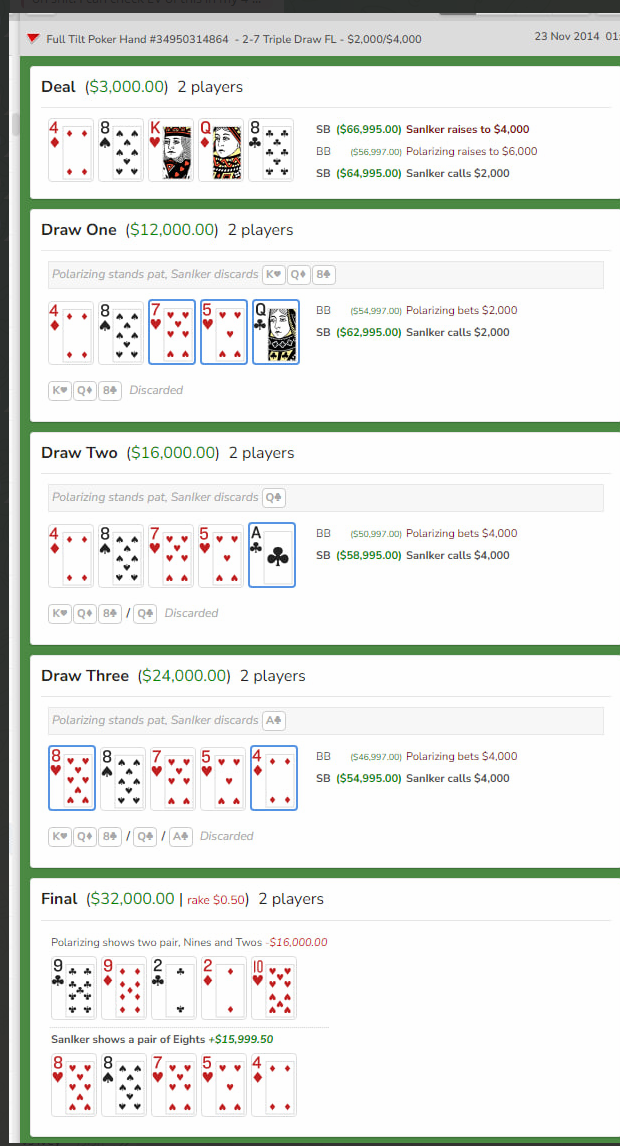
Here’s an epic hand versus Phil Ivey (“Polarizing”)
RaulG says:
“I remember snapcalling and him timing down a lot next hand preflop.
Exploit was that people didn’t do any thin valuebets and basically never bet 9-high in those spots. So having 888 blockers was quite huge”
But a bigger fight against Phil Ivey was coming up.
Timofey vs Phil Ivey
In November 2015, after 2–7 TDFL action died out, Trueteller challenged the legend himself, Phil Ivey, to an 8-game match.
They played 40,000 hands at $400/800. Trueteller won at 1.3BB/100, $400,000 at the table itself — also there was a crossbook on top of that. I cannot share details, but it was up to 10x.
I made around $200,000 from that match — it feels extra nice to win that from an old legend.
Timofey prepared using the TDFL solver, Razz solver, and we also calculated an exploit strategy for FLHE. Stay tuned for more details.
Vegas cash game
After online games were over, the highest Draw game in the world was a part of a mixed live cash game in Las Vegas. Every year during WSOP there is a game with big blind between $3000 and $5000 (buy-in around $400,000), with 10–15 poker variants being rotated.
Trueteller was so infamously good at Triple Draw, that Doyle Brunson and others voted to play ‘anti-Timofey mix’ which had Triple Draw specifically removed https://x.com/TTimofey_K/status/1793364118260396233
Jungleman
In 2017, Trueteller introduced me to Jungleman and we made a deal for Triple Draw, Single Draw, Razz and Omahas.
In 2021 and 2022, Jungleman won the $50,000 WSOP Players Championship back-to-back. It was great to feel part of such success on the biggest stage. Here’s the interview with Jungleman with more details, including how many hours he studied and how much winrate he attributes to the solver https://medium.com/@olegostroumov/interview-with-jungleman-f3618dace386
Today, you can play against the Triple Draw solver for free at draw.olegsolvers.com
Reach out to me for the full version! Price starts from $13,900.
Special thanks to Volker ‘RaulG’ for digging up hand histories and results.
Thanks to Timofey ‘Trueteller’ and Daniel ‘Jungleman’ for their help with the article.
Thanks to R Nikhil, Joe Ingram, Ian Chen, Alex ‘Kanu7’ Millar, Alexander Elenskiy, Ivan Bogatyy for reviewing the draft.